Skopje 2028: The City Rebuilt Before
Updated: Aug 3
Once rebuilt through architecture after the 1963 earthquake, Skopje is preparing for another kind of transformation. As European Capital of Culture 2028, the city is turning to culture, public space and its layered urban identity to ask what renewal can mean today.
Skopje is not a city that has only inherited its identity. It has had to reconstruct it. After the earthquake of 1963, the city became one of the most ambitious urban rebuilding projects of the 20th century; a place where planning, international solidarity and civic imagination were asked to work together. More than six decades later, the question returns in another form: how can a city renew itself through culture?
For 2028, the answer is not another masterplan, but culture itself: its ability to strengthen connection, public life and the many layers that already shape the city. Its European Capital of Culture title does not arrive on a blank page; it arrives in a city that already knows what it means to begin again. That earlier act of reconstruction is explored in Skopje in Concrete Terms.

An Introduction to Skopje 2028
On 26 July 1963, an earthquake destroyed much of Skopje and turned the city into an international reconstruction effort. The United Nations became involved, governments sent support, and architects and planners from across the world contributed to the city’s new form.
The most famous proposal came through the international competition for Skopje’s city centre, won by Japanese architect Kenzo Tange and his team in 1965. Developed as a reconstruction master plan in 1966, it was organised around the ideas of the City Gate and the City Wall. Though only partly realised, the plan gave Skopje a new architectural language based on movement, infrastructure, monumentality and collective life.

The buildings that followed shaped the modern image of the city: the Central Post Office, GTC, Goce Delčev Student Dormitory, the Museum of Contemporary Art, the Opera and Ballet, the UKIM campus and other public institutions in concrete. What emerged was not a single style, but a charged urban landscape: towers, raised platforms, angular cultural buildings, open commercial passages, campuses and public structures designed for a future that felt both urgent and unfinished.
Skopje 2028 belongs to this longer story. The city was recommended for the European Capital of Culture title in 2023 and nominated for 2028, alongside Bourges in France and České Budějovice in the Czech Republic. Its cultural programme is framed by the idea of Culture over Division, a phrase that feels less like a slogan than a condition of the city itself.
The importance of 2028 lies here: Skopje is not simply preparing for a festival year. At its best, it can become a way of reading the city again: through its bazaar and modernist centre, through its riverbanks and institutions, through independent artists, public spaces, schools, housing blocks and the civic energy that still moves through its post earthquake buildings.

Two Forms of Reconstruction
Skopje’s 2028 story is built on two forms of reconstruction. The first was physical: homes, schools, institutions, roads, cultural buildings and a new centre after 1963. The second is cultural: strengthening connection, participation and public life without reducing the city’s complexity to a single image.
Seen from this angle, the city’s modernist heritage becomes more than a visual reference. Brutalist Skopje is often admired for its concrete forms, but its deeper value lies in the ambition behind them. These buildings were part of a public project. They were designed for education, communication, culture, housing, commerce and collective movement. They remind us that buildings can carry social intent, not only image.

GTC opens itself as a passage through the city rather than a closed shopping centre. The university campus gathers students inside a dense concrete world. Goce Delčev Student Dormitory stacks and connects housing into something almost infrastructural. In each case, architecture is not treated as an object to be looked at, but as a structure for use, movement and shared life.
There is also a sense of buildings carrying two directions at once. Some look futuristic, shaped by Metabolist thinking and the idea of the city as a living system. Others feel older than their date, closer to fortifications, civic markers or fragments of an invented urban order. Janko Konstantinov’s Central Post Office is the clearest example: part communication hub, part monument, part object from another century that has not happened yet.

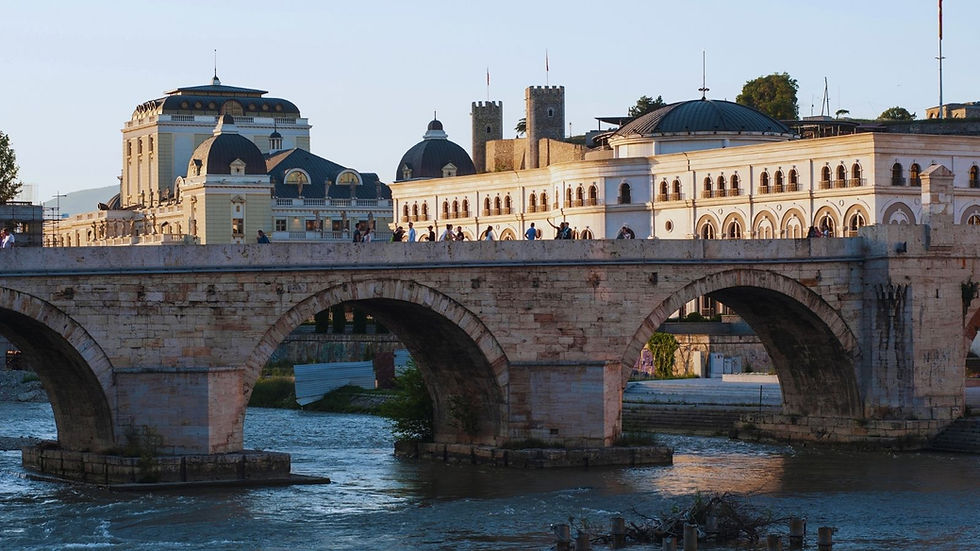
The Old Bazaar adds another urban language to the story. It's one of Skopje’s strongest cultural landscapes: commercial, religious, craft based, Balkan, Ottoman and still active. Across the Vardar, the post earthquake city speaks through concrete, platforms, campuses and cultural complexes. Between them stands the Stone Bridge, not as a simple symbol, but as a useful image for the whole project: Skopje’s future may depend on how these layers are allowed to meet.

From Title to Programme
The 2028 programme gives this idea a working form through five lines: Art4Hope, Togetherness, rECOvering, CreARTing and Heritage. Together, they move between emotion, community, ecology, artistic production and cultural inheritance. The themes are broad, but their potential is specific: underused buildings, riverbanks, cultural institutions, young people, neighbourhood life and the need for more generous public space.
Scale matters here. European Capital of Culture titles bring concerts, exhibitions, performances and visitors, but their real test begins after the year ends. The measure will not only be how much takes place in 2028, but what remains afterwards: stronger cultural institutions, more confident independent scenes and public spaces that continue to work for the people who use them.
The open calls are important because they move the project from announcement to production. With cultural co financing planned in the years leading to 2028, the programme can begin to take shape before the title year itself. The strongest projects will be the ones that do not treat the city as a backdrop, but work with what is already there: river edges, bazaar streets, housing blocks and the unresolved questions between them.

Key Forces
Skopje 2028 does not have one architect in the way the post earthquake reconstruction had Kenzo Tange. Its forces are more dispersed: cultural workers, city institutions, artists, universities, local communities, European partners, independent organisations and citizens. This makes the project harder to summarise, but also more fitting for the present.
The 2021 to 2030 cultural strategy positions culture not as decoration, but as part of urban development, decentralisation and civic participation. That broader view feels necessary in a city where neighbourhoods, informal spaces and independent actors are also essential to cultural life.
The UNESCO Culture|2030 Indicators process widens the frame. By measuring how culture contributes to sustainable development, it places the city inside a broader conversation about resilience, inclusion and the 2030 Agenda. This should not be overstated as a guarantee of transformation, but it does help shift the language around culture from event making to long term value.
That long view also reaches back to the city’s post earthquake reconstruction. Skopje’s built identity was shaped by local, Yugoslav and international architects working across different programmes and scales. Tange gave the reconstruction its most famous conceptual frame, but the city’s actual presence came from many hands.
Janko Konstantinov gave civic infrastructure an almost ceremonial force with the Central Post Office and Telecommunications Centre. Georgi Konstantinovski brought a powerful structural imagination to the Goce Delčev Student Dormitory. Živko Popovski’s GTC offered a different model: less monumental from a distance, but deeply urban in use. Marko Mušič’s UKIM campus gave education a dense architectural setting. Biro 71 brought a sharper expression to the Vardar riverfront with the Opera and Ballet. Boris Čipan, Krsto Todorovski, Radomir Lalović, Olga Papeš and others helped give institutions, science, banking and culture strong architectural bodies.

The Legacy of Skopje 2028
The legacy of Skopje 2028 will depend on how carefully it works with the city that already exists. In the 2010s, Skopje’s centre changed through new facades, monuments and a more historicist urban image. That period remains part of the city’s contemporary story, while also making the post earthquake buildings more visible by contrast.
The opportunity for 2028 is to work with complexity rather than reduce it. It can show the Old Bazaar and the modernist centre not as opposites, but as two parts of the same urban story. It can treat post earthquake buildings not only as photogenic concrete, but as evidence of a public ambition that still has something to teach. It can bring culture into neighbourhoods, not only into institutions. It can allow repair to mean care, access, maintenance, participation and shared visibility.
Many European cities are now asking how culture can do more than attract visitors. In Skopje, the question has a particular resonance because the city has already lived through one of the 20th century’s most dramatic acts of urban reconstruction. Its 2028 title arrives in a place shaped by Ottoman, Yugoslav, post earthquake, post socialist and European layers, none of which can fully explain the city on its own.
The promise of Skopje 2028 is not to give the city one clear image. It is to let its different parts speak to one another more clearly. After 1963, Skopje rebuilt through architecture and solidarity. In 2028, culture has the chance to continue that work in another form.
