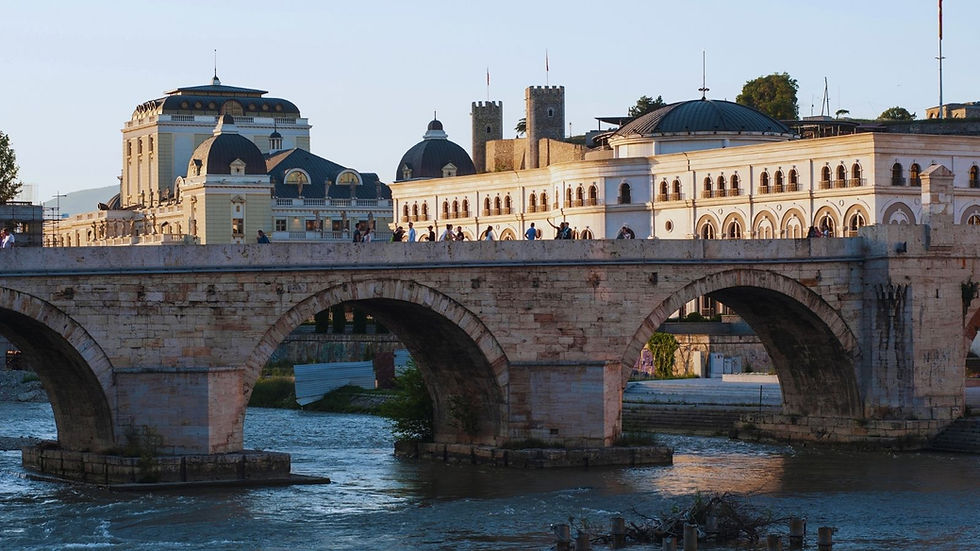
Skopje, in Concrete Terms
Updated: Jul 8
The travel gaze is shifting from the pretty to the unresolved. Skopje belongs to this shift: a city shaped by concrete, reconstruction and questions of taste. It is not polished and that is precisely why it feels relevant now.

This is not a story about Brutalism as a passing visual trend. In Skopje, concrete is tied to the city’s own rupture. After the devastating earthquake of 1963, the city became a site of reconstruction, international ambition and architectural experiment. Its Brutalist buildings were not added as nostalgic gestures or visual statements. They belonged to a moment when Skopje had to imagine itself again.
That is what makes the city different. Its concrete landmarks carry the trace of recovery, but also the tension of what came after. Some were neglected, some debated, some visually interrupted by later attempts to give the city a more classical face. The result is a place where architecture does not sit quietly in the background. It argues with time.
Today, Skopje feels newly relevant because contemporary travel is no longer only looking for the beautiful, the preserved or the perfectly arranged. It is also drawn to visible contradictions. In Skopje, concrete becomes a form of memory: imperfect, monumental, contested and still very much alive.
Together, the buildings below belong to Skopje’s modernist and Brutalist legacy: a concrete landscape shaped by reconstruction, public life and the changing politics of taste.

Central Post Office
Designed by Janko Konstantinov and completed in stages between 1974 and 1980, Central Post Office is one of the city’s most iconic examples of sculptural Brutalism. Its concrete volumes give a public utility the presence of a monument.
After a major fire in 2013 damaged the Counter Hall and much of the original interior, parts of the complex remain in use while its most iconic sections still await full restoration.

City Trade Center
Designed by Živko Popovski in 1969 and opened in 1973, it was conceived as a partly open, multi-level commercial passage where Modernist and Brutalist ideas meet urban planning. During the Skopje 2014 period, proposals for a neoclassical redesign prompted public debate, but civic resistance helped preserve its original modernist character. Integrated into the everyday flow of central Skopje, it continues to function as an active shopping centre, transit route and public meeting point.

The original Government Building 
After the Skopje 2014 transformation
Government Building
Designed by Petar Muličkovski and built between 1968 and 1970, the building was originally a Modernist Brutalist landmark. As part of Skopje 2014, its exterior was later reclad in a Neoclassical style. Still in use as the government building today, it stands as one of the city’s clearest examples of how architecture can be visually rewritten.

Hydrometeorological Service Building
Designed by Krsto Todorovski and developed between 1972 and 1975, the Hydrometeorological Service Building is one of Skopje’s most unusual examples of Brutalist and Late Modernist architecture. Set on a hill overlooking the Vardar valley, its raised volumes, cylindrical supports and technical character give the institute a striking presence above the city. Today, it continues to house the State Hydrometeorological Institute of North Macedonia, preserving its original function.

The original late modernist form 
Today, still active as a public school
Josip Broz Tito High School
Designed by Vasilka Ladinska, Živko Gelevski and Slavko Gjurikj, Josip Broz Tito High School was developed between the late 1960s and early 1970s. Its functional educational architecture carries the influence of Late Modernism and Brutalism, with a clear emphasis on structure and public use. Today, it remains one of Skopje’s best-known state high schools and is also part of the International Baccalaureate network.

Macedonian Academy of Sciences and Arts
Designed by Boris Čipan and completed in 1976, the Macedonian Academy of Sciences and Arts reflects the institutional ambitions of Skopje’s reconstruction period. Its Late Modernist architecture blends contemporary form with local and regional references, belonging to a city that was rebuilding not only streets and housing, but also cultural and intellectual life. Today, it continues to serve as the country’s leading academy for science, research and the arts.

Museum of Contemporary Art
Donated by the Polish government and designed by the Polish architectural group known as the Warsaw Tigers, the Museum of Contemporary Art opened in 1970 on a hill above central Skopje. One of the city’s clearest architectural signs of international solidarity after the 1963 earthquake, its postwar Modernist form gives the museum a calm, elevated presence near Kale Fortress. Today, it remains active as a museum for national and international contemporary art.

Museum of the Republic of North Macedonia
Designed by Mimoza Nestorova-Tomić and Kiril Muratovski, the Museum of the Republic of North Macedonia was built between 1971 and 1976 on the edge of the Old Skopje Bazaar. Its Modernist volumes respond to the historic fabric around them, turning a large museum complex into part of the city’s cultural landscape. Today, it houses major archaeological, ethnological and historical collections.
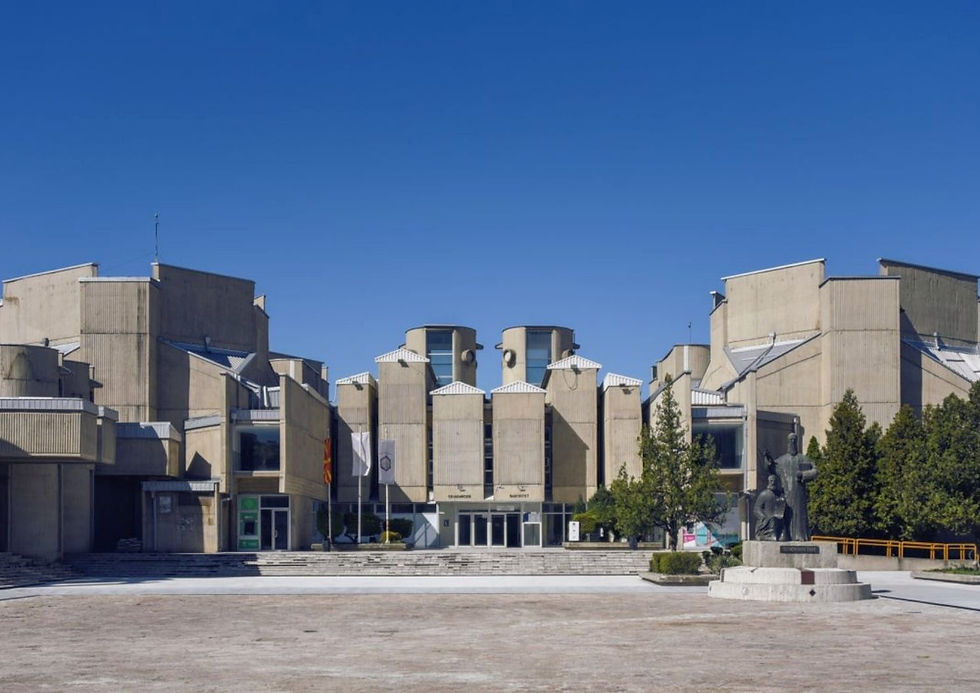
Saints Cyril and Methodius University Campus
Designed by Marko Mušič and completed in 1974, the Saints Cyril and Methodius University campus is a dense educational complex of cast concrete forms, internal routes and gathering spaces. Conceived almost as an academic city, it brings Brutalist architecture together with megastructure thinking and traces of Metabolist urban ideas. Still active as part of UKIM’s main campus, it gives the university the feeling of a city within the city.

National Opera and Ballet
Designed by the Slovenian architectural group Biro 71 and developed during the 1970s, the National Opera and Ballet is one of Skopje’s most expressive examples of Yugoslav modernism. Its folded white concrete planes, fragmented geometry and position by the Vardar River create a distinctive cultural landmark, showing how architecture can shape a city’s image without relying on nostalgia. Today, it remains active as one of the city’s main stages for opera and ballet.

NaMa Department Store
Designed by Slavko Brezoski before the 1963 earthquake, the NaMa Department Store shows that modern architecture in Skopje did not begin with reconstruction. One of the city’s early modernist commercial buildings, it once brought rational lines and open retail planning to the centre of Skopje. Its later alterations reveal how easily 20th century buildings can be changed, disguised or visually overwritten. Here, photographed in 1962, before later alterations changed much of its original modernist character.

Goce Delčev Student Dormitory
Designed by Georgi Konstantinovski, Goce Delčev Student Dormitory turns student housing into a concrete megastructure. Its stacked volumes and elevated bridges capture the experimental confidence of Skopje’s post-earthquake reconstruction period. Still used by students today, it brings the city’s architectural story back to education, youth and the future of staying in Skopje.

Pestalozzi Elementary School
Designed by Swiss architect Alfred Roth and built with Swiss support after the 1963 earthquake, Johann Heinrich Pestalozzi Elementary School brings Skopje’s reconstruction story down to the scale of education and everyday life. It is a reminder that international solidarity in the city was not only monumental; it was also practical, civic and built around children.
Photos: Courtesy of northmacedonia.architectuul.com / State Archives of the Republic of Macedonia / Wikimedia Commons / OOU Johann Heinrich Pestalozzi