The Architects of Looking
Updated: Aug 5
From Gaudí’s façades to Hockney’s pools and Saint Laurent’s clothes, some surfaces do more than appear. They slow the eye, redirect attention and change how looking begins.

A surface is never neutral once it starts to guide perception. It can make a building feel unstable, turn cloth into authority, break a pool into fragments of light or make a familiar room suddenly worth studying. What matters is not the material alone, but the way it teaches the eye to move.
This is where very different figures begin to meet. Antoni Gaudí, Gianfranco Ferré, Yves Saint Laurent, David Hockney, Giorgio Morandi, Mary Cassatt, Bill Cunningham and Paul Klee did not simply make buildings, clothes, paintings or photographs. They changed the surface on which looking begins.
When a Surface Becomes Structure

In Gaudí’s work, the façade is never simply the outside of a building. It becomes a terrain for the eye: stone bends, swells, casts shadows and refuses the discipline of the flat wall. The building is not only seen from the outside; it makes looking itself move.
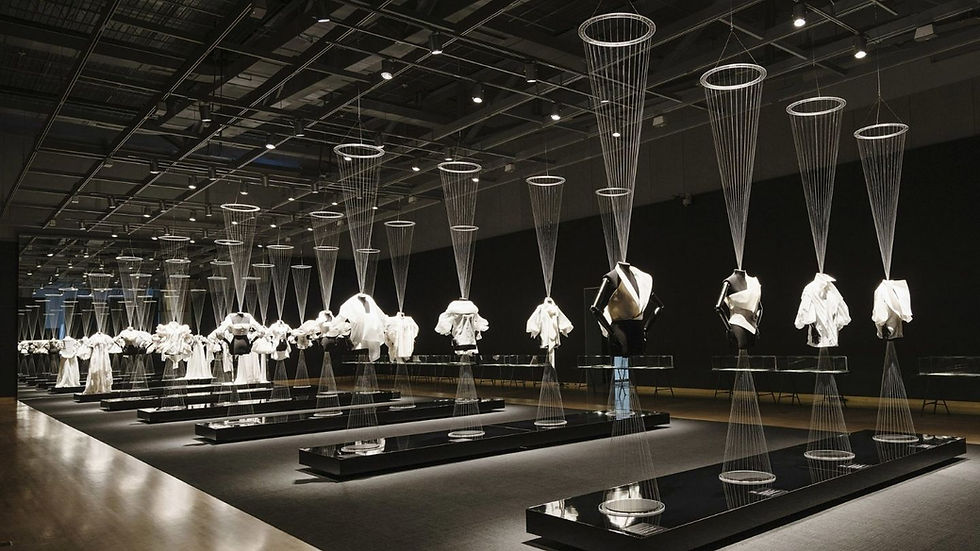
Ferré approaches cloth with a similar refusal of flatness. A white shirt is not treated as a soft rectangle wrapped around the body, but as a structure made of folds, volume, collar, cuff and light. The surface is worn, but it is also built.
When Surface Becomes Attitude
Saint Laurent understood that fabric could change how a body was read in public. A tuxedo, a safari jacket, a Mondrian dress: none of them functioned only as clothes. They shifted the terms of femininity, authority and visibility. Surface became more than material. It became posture, permission and social language.

Movement, Stillness and the Surface of Attention

On Hockney’s pool surfaces, nothing stays still for long. Water breaks the image into light, reflection and colour; the eye cannot settle into a single point of view. What seems flat is already moving.
Morandi does the opposite, yet arrives at a similar intensity. Bottles, boxes and vessels barely move, but the act of returning to them again and again slows perception. The objects are present, but so is the silence between them. In his work, attention gathers not through drama, but through repetition.

The Seriousness of the Ordinary

Cassatt gives domestic interiors the weight often reserved for public scenes. Fabric, furniture, posture and proximity become part of the image’s architecture. The room is not background, but a structure of attention.
Cunningham reads the street in a related way. A coat, a hat, a bicycle, a sudden colour on the pavement: these are not accessories to the city, but signals within it. He turns passing surfaces into an archive of how people choose to appear.

A Line as a Place to Think
Klee brings the question back to the smallest possible surface: a line on paper. His marks can seem simple, almost childlike, but they behave less like decoration than direction. A line becomes a way of thinking, a small architecture for the eye to follow.

A Way of Looking, Left Behind
By coincidence, these figures all left the world in June. But what remains is less a calendar of departures than a set of ways to look: slower, closer and with more attention to the surfaces we usually pass over.
Their common ground is not style. It is the way they trained the eye to see surface as something active: able to hold a body, disturb a wall, catch a reflection, structure a room or turn an ordinary street into evidence. What endures is not only what they made, but how they changed the place where looking begins.
Magelier Notes: A Surface After Gaudí

Go on a trip. Visit an iconic architectural site. Come back inspired. That was the formula Daniel Roseberry thought he could repeat. For Schiaparelli Haute Couture Fall Winter 2026–2027, the creative director went to Barcelona expecting Gaudí’s work to unlock the collection. Instead, the idea of a perfect creative process began to fall apart.

The collection found its shape only when control gave way to uncertainty. In Look 27, architecture returns as surface: a glazed pale pink silicone bodice, fish scales, hand painted flowers, ribbons and a sculptural bow. It does not copy Gaudí. It borrows his logic of movement, excess and living ornament, letting the body become a strange little façade of its own.
Opening image: Portrait of an Artist / Pool with Two Figures, 1972, David Hockney
Image Credits: David Hockney, Portrait of an Artist, 1972, David Hockney Foundation / Christie’s. The White Shirt According to Me: Gianfranco Ferré , Gianfranco Ferré Foundation / Phoenix Art Museum; Yves Saint Laurent, Mondrian dress, Autumn-Winter 1965 Haute Couture collection, Musée Yves Saint Laurent Paris / © Yves Saint Laurent; David Hockney, A Bigger Splash, 1967, Tate, UK; Giorgio Morandi, Natura morta, 1942, Guggenheim Museum Bilbao; Mary Cassatt, The Child’s Bath, 1893, The Art Institute of Chicago, Robert A. Waller Fund, 1910.2; Paul Klee, Twittering Machine, 1922, The Museum of Modern Art, New York.


