What Remains
- Jun 27
- 12 min read
Updated: Jun 27
Working between Datça and Istanbul, sculptor Korkut Sönmez treats marble and bronze as vessels of time. In this conversation, he reflects on Knidos, belonging, permanence and the act of removing what is unnecessary until a form reveals itself.

Korkut Sönmez’s sculptures begin with weight. The weight of marble and bronze. The weight of a witness, a memory, a question that refuses to disappear.
Shaped by the ancient presence of Knidos, Sönmez approaches sculpture not as an act of addition, but as a search for essence. His forms emerge slowly, through patience and a careful attention to what a material can carry.
His works move between archaeology and contemporary life, between personal reckoning and collective memory. A rhinoceros becomes a symbol of strength and survival, but also of the way culture turns meaning into decoration. Kevin Carter’s photograph opens a space for thinking about hunger, conscience and the burden of witnessing. Elsewhere, Duchamp and the cicada shift the focus toward beauty, thought, patience and the joy of living.
What remains, in Sönmez’s work, is never only an object. It is memory given weight.
We spoke with him about Knidos, permanence, beauty, patience, and the possibility that art can outlive both its maker and its time.

Prof. Dr. Ertekin Doksanaltı, Head of Excavations at Knidos, has described your work as a local sculptural voice emerging from this landscape after a long historical silence. Does this connection create a sense of responsibility, or a deeper sense of belonging?
We grew up on the peninsula almost like children who might have lived there two thousand years ago, in a world of nature and simplicity, far from technology. My sense of belonging only began to appear when I encountered the city. Perhaps the first thing that set my artistic journey in motion was the feeling of belonging to these two different worlds.
As for the weight of that title, Knidos is a place where even its ruined state is a visual feast, where the weight of a city shaped by deep experience and an extraordinary concern for beauty can be felt everywhere you look. I tried to lighten that weight by approaching it with great care, by filtering it finely, and by making it my principle to remain original and sincere.
How has being born in Datça, growing up in a geography surrounded by water and stone, reflected on your sculpture? Does geography shape a person’s hand and gaze?
What we acquire from life begins with the geography into which we are born, the place we perceive with all our senses, the place where we pass through that turbulent period of adolescence when both body and soul reach an impasse. It is undeniable that we are shaped by the ethnic life of that place.
Every person’s unique existence begins like this, wherever they are born, but these are only the ingredients. What matters is how well you cook it and how you finally present it. In that sense, I was lucky to have teachers in my primary and secondary education who guided me in the right direction. I was a child who read a lot, sensitive and curious, and I think that was when I took the first steps towards forming a language of my own.
The presence of water and the scent of history in my sculptures are gifts from the geography I come from.
For you, does a sculpture begin as an image, a thought, or the emergence of a feeling?
A thought can become something, a presence, only when it extends over time, mixes with your existential concerns, and turns into a feeling you catch in the moment. Then you begin to search for how you can express it as form. The image is the clearest execution of the birth of the sculpture.
In your manifesto, you say that sculpture is about removing excess. Today’s world, however, is constantly adding and multiplying. Do you think there are also excesses in human life that need to be carved away?
Getting rid of excess is a phrase Michelangelo used to describe reaching the essence, and it is almost an aim for many of us in sculpture. Our greatest burden is our excess. If you think about the moments when we feel at our best, they are usually marked by calmness and simplicity.
Modelling is, in fact, the beginning of the discipline of sculpture. You remove what is excessive and add what is needed. I sometimes wish our lives could be controlled as much as that process. I believe today’s world will eventually find its point of balance in the process it is going through, although it is difficult to know when. In the meantime, the artist has to build an invisible shield for themselves through music, cinema and literature.
Bronze and marble appear frequently in your work. Do you choose these materials purely for their aesthetic qualities or is their sense of weight and endurance also important to you?
In my sculptures, my choice of material is limited to marble and bronze. As you say, their resistance to time and the sense of weight they give to a sculpture are very important to me. The fact that a work may live thousands of years longer than its maker brings with it a sense of responsibility towards the thousands of viewers it may one day meet. This increases both my sense of responsibility and my respect for the material, and makes me more careful and disciplined in the process.

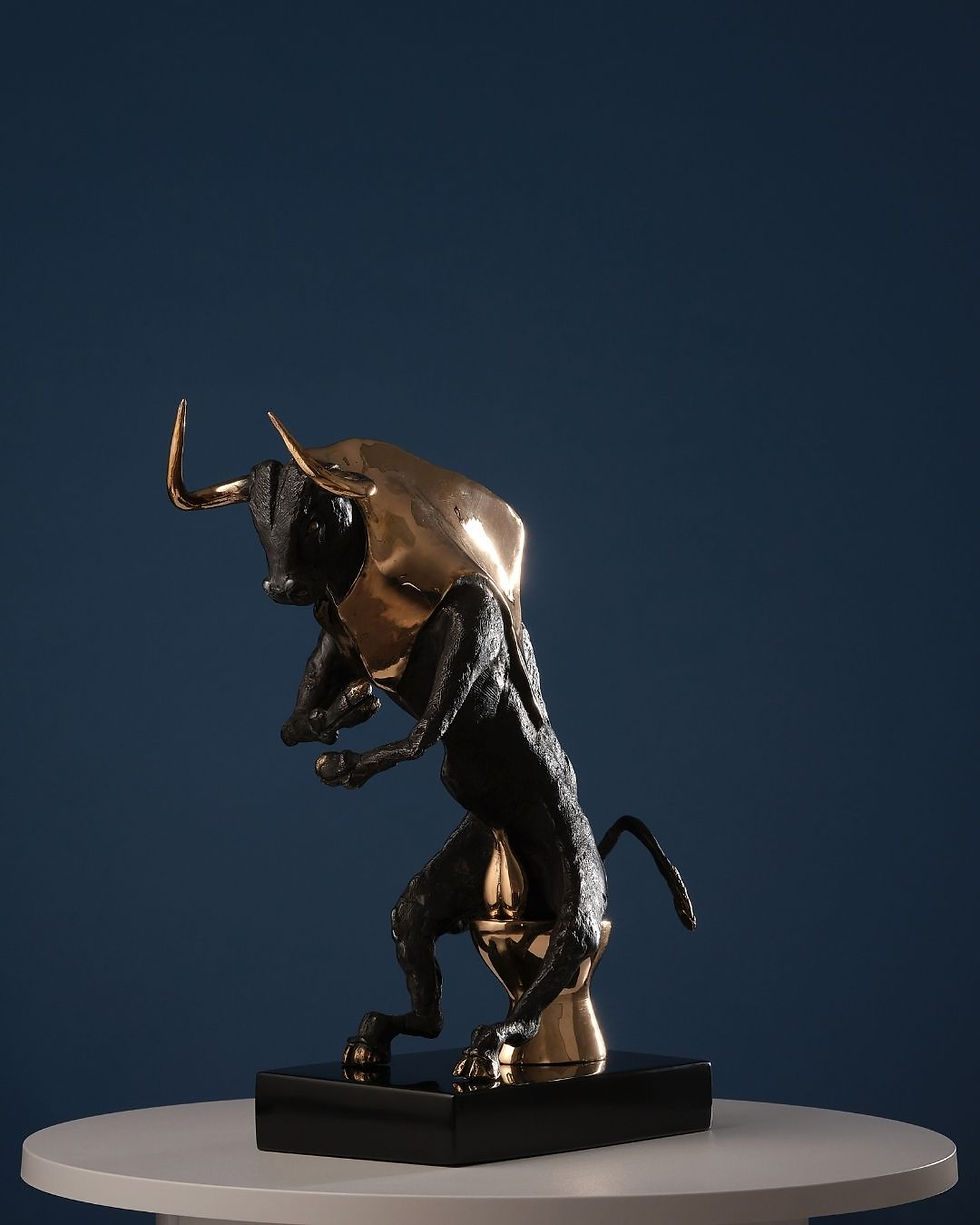
In Rhinoceros, you approach this powerful animal both as a symbol of strength and survival, and as a figure that popular culture has turned into decoration. What do you think humanity most often makes invisible by turning it into decoration?
What humanity makes invisible by turning things into decoration is, above all, its way of experiencing and perceiving the moment. A work of art that carries an emotional bond, and has passed through the aesthetic filter of the mind, gives something back to the viewer each time it is seen. It exists beyond consumption. Anything placed in a home, a collection or a display without curiosity about its meaning or origin risks becoming invisible. It remains an object, but only as part of a habit of consumption. It doesn't teach, it doesn't develop us, and at the same time it is barren and numb.
Can a figure become so visible that it is no longer truly seen? As with the rhinoceros, does the constant repetition of an image diminish its meaning?
This depends less on what that highly visible thing is, and more on why it was created. I, too, published my own manifesto on the rhinoceros. The first was titled I Poured Out My Heart, true to its name. I also wrote another manifesto on this subject under the title Rhinoceros Culture.
Does encountering an image everywhere reduce its meaning? I don't think so. In my view, variety enriches us. It makes us more selective, and leads us to think, and therefore to examine more deeply.
At the point we have reached, has the rhinoceros, with its symbolic meaning and the powerful, aesthetic presence of its body, not become an object that is unseen, unheard and even unknown, while decorating the most beautiful corner? The rhinoceros is simply moving through this process a little faster. Otherwise, humanity’s way of behaving towards its own species is not very different.
In my work, I place the rhinoceros figure on a latrine from the Roman period. By letting half of its body flow into the memory of the earth as a historical document, I make a reference to popular culture.

In the To Dedicate series, you enter difficult territory through Kevin Carter’s photograph, engaging with hunger, death, witness and conscience. How should an artist approach such suffering, and where should the boundaries lie?
Kevin Carter paid with his life for having no chance to draw a boundary before that reality. As artists, we move through sensitive territories. In this case, aesthetically, I was only the witness of a witness, one that had settled into an extraordinary place. With that responsibility, I carried these two sculptures in my mind for years, thinking that perhaps I had come close to only a very small part of what Carter, the true witness, may have felt.
It took me a long time to find that balance in sculpture. In the end, I was able to create two abstract figures that, beyond pain, carry a monumental sadness, and meet what life brings with courage and the evolution of innocence.
For me, art is a medium where the unknown, my existential questioning, pains so heavy they are almost impossible to overcome, and hope all evolve. That is why each sculpture is, for me, a kind of liminal space, one in which I feel deeply alive and productive at every stage of its process.
Carter’s photograph was read for years as the symbol of a tragedy, until new details about the child’s story later emerged. Should art and photography remind us not only of reality itself, but also of how incomplete reality can remain?
Art and photography continue to show reality, while also reminding us that reality can remain incomplete. In 2011, the world learned that the child in the photograph, long known as the girl in the image, was in fact a boy and that he had survived.
Carter’s greatest contribution was not only the image itself, but the fact that it brought what was happening in that region to the attention of the whole world and allowed sensitive people to contribute. That is where we see the true power of art. Through my own work, I also wanted to contribute to this conversation.
If a work of art didn't ignite curiosity, one could say that archaeology itself could hardly begin its work. Truth can remain incomplete. It may be buried, as at Göbeklitepe, but sooner or later it comes to light.
In this context, To Dedicate I and To Dedicate II were later included in Beyond the Past, an exhibition opened at the Urfa Archaeology Museum as part of the World Neolithic Congress, the first of its kind, which brought together more than a thousand academics, archaeologists and scientists from sixty three countries. The exhibition was curated by Serap Gümüşoğlu and coordinated by Yasemin Aslan Bakiri, at the invitation of Excavation Director Prof. Dr. Necmi Karul.
The distance a work of art can connect across is truly beyond time.

Your phrase, “For children lost to hunger, eternity is a gift,” is both harsh and poetic. Is eternity, for you, a consolation, a protest or a mirror held up to humanity?
Is eternity not a form of consolation for every living being that has suffered injustice? It is a state freed from all the noise and anxiety of the earth, a pure and absolute stillness. Through this phrase, I am consoled, but I also object. In that sense, as you said, I confront myself through it.
Marcel references Marcel Duchamp, who argued that art should speak not only to the eye but also to the mind. Do you think it is still important for art to make people think, or can beauty alone be enough?
Marcel is the first sculpture of what will become my fourth solo exhibition. Its manifesto moves forward by "turning the needle towards myself".
For me, a work of art is the embodied form of aesthetics and thought, brought together around what it seeks to express. A work of art cannot exist without aesthetics and conceptual depth. Objects created only through an idea of beauty lack the elements I am referring to, and for that reason they remain merely decorative objects.
In our time, this has affected architecture in particular. As we can see, architecture has been negatively shaped by the dangerous advance of beauty as an idea, and by the absence of the aesthetic understanding of earlier periods. Beauty, if it's not grounded in aesthetics, can become a dangerous concept.
Your sculptures are beautiful, but their beauty feels contemplative rather than comforting. Can a sculpture be both beautiful and unsettling at the same time?
I am glad you see that in my work. It's actually one of the things I most hope viewers will feel when they encounter it. There are many examples we could give. Is this not the feeling we have in front of some works that have entered the history of world art and have been internalised by millions of viewers? The first example that comes to mind is Edvard Munch. But I could also mention the works of Alberto Giacometti, Michelangelo’s Pietà, and many others.
There has probably always been the idea, or the desire, that a work of art should make us feel good and refresh the spirit. But today, I think we have reached a point where, in almost every area, our speed and stressful ways of living make us see art almost like a form of medicine.
A work of art enters into a private space with its collector or viewer, and this already creates a kind of rehabilitation space. But first, one has to look at it with patience and form a connection with it. Even the best painkillers only work for a limited time. A work of art can heal for a lifetime, through a true and sincere encounter.
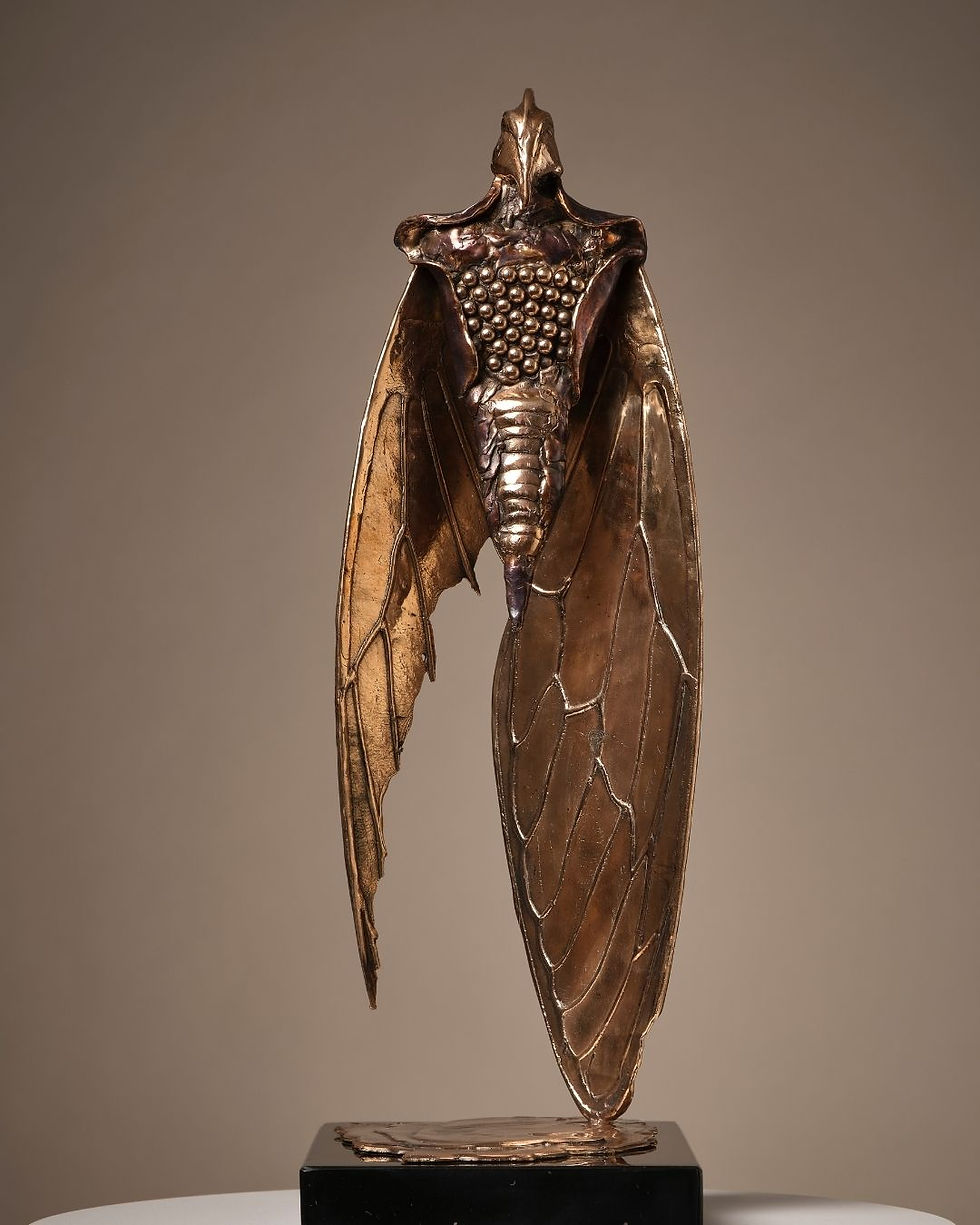
From the life cycle of the cicada, you move toward ideas of patience and cyclicality. What does patience mean to you in a culture obsessed with speed?
Today’s idea of speed is a problem for all of us. Patience has become a concept whose cost and effect reveal themselves only in certain areas. If we cannot establish balance, something in us may remain incomplete on the path we are taking.
To execute a sculpture before it has completed its own evolution in my mind may save the day, but it also stains my spirit. Patience means processing that evolution correctly. To avoid being harmed by the process, one needs discipline. You have to keep your concentration strong, so that you don't become a victim of speed before reaching patience.

In Cicada, you speak about the joy of living until the very end, but you also suggest that this is difficult for many people to bear. Why do you think people can be afraid even of the joy of living?
This brings us to one of the fundamental questions of existence, because this is entirely the dialectic of life. In Cicada, I emphasise knowing the value of life precisely because the cicada’s lifespan is so short. When does this sense of value begin? I think it begins when we become aware of life’s inevitable contradiction. What I actually mean is that the joy of living can become something that grows even stronger through the awareness of mortality.
You work between studios in Istanbul and Datça. Do these two places bring out different sides of you as an artist? Does one belong more to thought and the other to material?
Thoughts are not things we can simply leave behind, but it's clear that places nourish us through space. The subjects I want to express are universal, and they become blended within that larger field. I love the particular magic of each place, and naturally this is reflected in my sculpture. I have made this rhythm more orderly and useful for myself: I do the modelling, the sculpture that will later become bronze, in Istanbul, and the carving in Datça. This order is good for both my body and my spirit.
Sculpture is a physical, demanding and often slow medium. How does it sit within a contemporary art world driven by constant circulation?
Working with materials drawn from the earth, such as marble and bronze, requires patience and precision. Compared with other materials, it's also more costly and demanding. In general, material carries a certain risk. Once a work reaches the collector, it may be exposed to wear over time. Any problem that arises can become a difficult situation for both sides. That is why I chose two materials that can endure for thousands of years. I also find it appealing that these materials gain value over time, especially in a material sense.

When a form begins to emerge, does your hand move ahead of your thoughts, or do your thoughts guide your hand?
The creative process is not something that is taught very much in academies. Every artist has their own way of creating a work of art. For me, the subject that catches my attention most strongly in the moment, the one that begins to trouble me, keeps turning in my mind for days, sometimes for years, wherever I am. Sometimes I cannot escape the thought even while having a conversation. Once I find the form, I continue thinking for a while longer.
Sometimes I feel closer to a form I had captured earlier; only the order of execution changes. Today, alongside clay, we have access to very durable materials, and thanks to this I can work on two or three sculptures at the same time. When my eye becomes tired of one work, I can move on to another. I gain time without breaking my concentration.
How do you know when a sculpture is complete? Is it finished when it leaves the artist’s hands, or when it finds its place in the viewer’s mind?
If I have a hesitation inside me about a sculpture, even when everything seems complete both intellectually and aesthetically, and I cannot make sense of that hesitation, then that sculpture is not finished. I have even broken sculptures before exhibiting them for this reason. Only when I can look at the finished work with ease, and feel that it has begun to nourish me as well, do I consider it ready to be shown.
The moment a sculpture leaves the artist’s hands, it becomes universal and begins to say more than the artist intended to say. The bond each viewer forms with it merges with their own lived experience and with the sculpture’s expressions, opening the way to a new field of thought. For me, a sculpture begins after it's finished. Sometimes I want to carve a sculpture until there is almost nothing left.
If a viewer were to leave your work carrying just one feeling or one question with them, what would you hope it would be?
When someone connects with a sculpture and, after listening to its manifesto, says, “Now I understand,” witnessing that moment of recognition is deeply satisfying. I think it's something like encountering the essence of being human. An indescribable feeling.